

TRANSFORMATION
INTO REAL
OUTCOMES.
For CIOs, CTOs, and transformation leaders responsible
for delivering real outcomes.
We eliminate the gap between strategy and execution—aligning
architecture, operating models, and delivery to drive measurable
outcomes and lasting enterprise momentum.


AUTHOR, DIGITAL MOMENTUM






Practical executive guidance for organizations navigating continuous transformation, AI
disruption, ecosystem competition, and execution complexity.

BUSINESS OUTCOMES
Organizations are investing heavily in AI but
struggling to connect experimentation to
measurable enterprise value, governance,
and operational execution.

PROGRAMS LOSING
MOMENTUM
Large-scale initiatives often stall between
strategy and delivery due to fragmented
governance, weak operating alignment, and
disconnected execution models.

BLOCKING AGILITY
Technical debt, integration friction, and siloed
platforms prevent organizations from adapting
at the speed modern markets demand.
strategy into continuous
execution.
“Most transformations don’t fail
because of technology—they fail in
the space between strategy and
execution.”
SCALING WITHOUT FRICTION


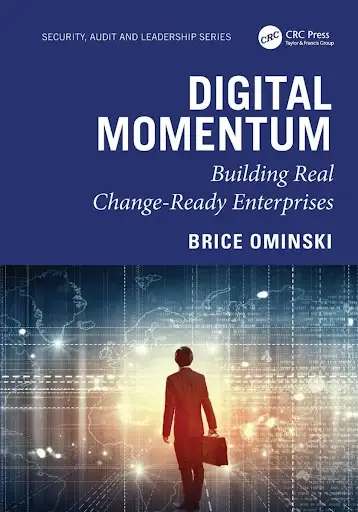
Digital Momentum is your new playbook for thriving in this world
of constant acceleration. Brice Ominski, a globally recognized
enterprise architecture leader, draws on decades of hands-on
innovation and insights from a worldwide community of
executives and practitioners.
This is more than strategy—it’s a toolkit for CIOs, CTOs,
enterprise architects, and technology practitioners navigating
relentless disruption. Build enterprises that evolve continuously,
orchestrate intelligently, and scale trust across ecosystems.

SEE WHAT ENTERPRISE LEADERS ARE SAYING ABOUT THE DIGITAL MOMENTUM
FRAMEWORK.
Digital Momentum is a must-read for business and technology leaders, architects, and anyone shaping the enterprises of today and tomorrow. At its core, this book is about the future of business and how to design with intent and for resilience in a digital world where value is the new currency and ecosystems are the new way organizations operate.
Architecture is not a technical afterthought. It is central to connecting strategy with execution, ensuring that people, processes, and technology work together to deliver meaningful outcomes.
Technically rich yet accessible, Digital Momentum defines what a truly digital enterprise looks like in a world shifting from goods-dominant to service-dominant business models. It provides practical blueprints for modular, composable design, introduces new ways to lead and govern for change, and importantly reminds us that every system we build carries ethical, strategic, and societal accountability.
Brice has created both an architect’s playbook and a leader’s guide for competing in an economy defined by co-created value, continuous evolution, and human-centered innovation. As the book makes clear, future-ready architecture isn’t a destination. It is a discipline, and Digital Momentum shows us how to apply it with purpose, intent, and the leadership necessary to thrive in the digital world that lies ahead.
Whynde Kuehn
Founder and Managing Director, S2E Transformation
Author, Strategy to Reality and Co-Author The Execution Challenge
Co-Founder, Business Architecture Guild
Review of “Digital Momentum: Building Real Change-Ready Enterprises”
Brice Ominski’s Digital Momentum is an insightful and timely read for anyone navigating the complexities of digital transformation. The book provides a solid foundation for enabling iterative yet transformative change as an enterprise capability, especially in today’s rapidly evolving, AI-enriched technology landscape.
Ominski focuses on the real challenges of integrating Artificial Intelligence into contemporary solutions and organizational transformation agendas. He offers relevant, composable, and future-ready frameworks for architecture, integration, governance, leadership, and change management, with a strong emphasis on continuous adaptation, ethical alignment, and visionary leadership.
This is a fantastic resource for anyone serious about building resilient, future-ready organizations. The book is aptly named: it is insightful, actionable, and future-focused: A rare combination that will inspire and accelerate your Digital Momentum.
Grant Ecker
Founder, Chief Architect Network and VP of Enterprise Architecture at Ecolab
I’ve been working through Digital Momentum over the past several months while writing my own series on strategic architecture, and it has earned a permanent spot on the short shelf of books I actually cite. Most “future of the enterprise” books deliver vision without operating instructions. Brice Ominski delivers both.
What sets this book apart is that the frameworks are designed to be used, not admired. The Ontology-Maturity Ladder gives architects a concrete progression for moving from team-level fluency to ecosystem-wide semantic interoperability. The Composable Highway reframes the gap between strategic intent and production execution as an architectural problem that can be solved, not a cultural problem that can only be lamented. The D³ Shift (Dematerialization, Democratization, Digital Momentum) gave me a vocabulary for explaining to executives why the old “stable state then reboot” approach is now actively dangerous, not just inefficient.
The four leadership imperatives in Chapter 16 are the part I keep coming back to: Make Trust Measurable, Treat Governance as a Force Multiplier, Version-Control Your Values, Lead the Rulemaking. Each one inverts a default assumption that quietly governs how most enterprises operate. The line “Trust isn’t built on perfection. It’s built on transparency” is the kind of sentence that changes how you write architecture decision records.
The Tesla example as the embodiment of “the product is the platform, the platform is the service, and the service is continuously learning” is perfectly chosen. So is the framing of governance as “a growth engine, not a gate” that single reframing has done more to unlock real conversations with my risk and compliance counterparts than any technical argument ever did.
If you’re an enterprise architect, a CIO, or a technology leader trying to articulate why composable, intent-aware, semantically rich architecture matters in business terms, buy this book. If you’re tired of transformation books that give you a vision and a poster but no patterns, you’ll find what’s missing here.
Highly recommended.
Shawn McCarthy
Senior VP IT at Manulife
Digital Momentum: Building Real Change-Ready Enterprises
I have to say this upfront: Digital Momentum is not really a book about digital transformation. That is an easy label.
Brice Ominski has written a book about why transformation keeps failing, why organizations keep confusing movement with progress, and why architecture has to move from the back room to the leadership table. That is the book’s real value. It does not treat architecture as documentation. It treats architecture as the connective tissue between strategy, execution, governance, ethics, people, and technology.
The central argument is both simple and uncomfortable. Enterprises cannot keep operating as if transformation is a project. The world no longer moves in neat technology cycles. Cloud, AI, data, platforms, ecosystems, automation, and intelligent systems have compressed the change window. By the time many organizations finish one transformation, the operating environment has already moved on. The old model of episodic modernization has become part of the problem.
Ominski calls the alternative Digital Momentum. That phrase matters. Momentum is not speed alone. Speed without direction is a waste. Speed without governance is risk. Speed without architecture is collapse waiting for a calendar invite. In this book, momentum means an organization’s ability to keep adapting without losing trust, purpose, or operational coherence.
The book is structured around that idea. It begins by describing the digital inflection point, the traps of legacy thinking, and the acceleration crisis facing modern enterprises. It then moves into the foundations of future resilience, including technical debt, postmodern systems, and executive control in service economies. From there, it expands into composable architecture, system archetypes, governance fabrics, and practical blueprints. The CoCover Insurance case study gives the book a working model rather than leaving the reader with theory alone. Finally, the book closes with the human side: ethics, agency, policy-driven architecture, and the role of people in a world of increasingly intelligent systems.
What I like most about the book is that it does not worship technology. It respects technology, but it does not confuse technology with transformation. That is an important distinction. Too many organizations buy platforms and call that strategy. Too many leaders launch AI pilots and call that innovation. Too many teams modernize systems without changing the operating model that made the old systems brittle in the first place. This book pushes back on that thinking.
The strongest sections are the ones that connect architecture to business value. Service-Dominant Logic, composability, semantic integration, trust fabrics, governance fabrics, packaged business capabilities, and outcome-driven design are not presented as buzzwords. They are presented as building blocks for enterprises that must operate across ecosystems, not just inside their own walls. That is where the book becomes especially relevant in the AI era. AI does not just need compute. It needs context. It needs governance. It needs trust. It needs an architecture that explains what is happening, why it is happening, and whether it should happen at all.
There is also a very important human message in the book. Ominski makes clear that future-ready enterprises are not just more automated enterprises. They are enterprises where people remain central as intent setters, governance participants, ethical stewards, and co-creators of value. That is a useful correction to the current AI conversation, which too often swings between hype and fear.
My only caution is that this is not a light read for the airport. It is conceptually dense. It introduces many terms, including cognitive mesh, composable governance, ethical and policy-driven architecture, semantic orchestration, and systems of trust. For executives looking for a quick checklist, the book may require more patience than expected. But that is also part of its value. Real transformation is not a checklist problem. It is a systems problem.
The audience for this book is clear. CIOs, CTOs, enterprise architects, transformation leaders, digital strategy teams, governance leaders, and AI program leaders will get the most from it. It is also useful for business executives who know their organizations are spending heavily on modernization but are not seeing durable change.
In my terms, this is one of those books that lands in the “keep close to the desk” pile, not the “read it once and shelve it” pile. You will not agree with every term. You may argue with some of the framing. Good. That means the book is doing its job. It makes you think about the machinery underneath the transformation, not just the press release above it. The big takeaway is this: enterprises do not need another transformation slogan. They need architecture for continuous change. That is what Digital Momentum gives them.
Scott Andersen
Founder
Creative Technology and Innovation
Brice’s book is an amazing read that struck me with a unique combination of depth and breadth. There are so many “golden nuggets” embedded in the text!
Similar to Paul Preiss, who has written the Foreword, I don’t necessarily agree with the author on everything, but the real value of the book is that it provokes people to start thinking about transformations more deeply and broadly.
This book will benefit the three top tiers of any organisation, as well as senior students.
Having said this, the book requires slow and thoughtful reading with pauses allowing one to think about various concepts and to allow them not only to sink in, but also to realise how they may and should be applied in the reader’s context. Dr Vladas Leonas
Adjunct Professor at the Australian Graduate School of Leadership
Brice Ominski’s Digital Momentum: Building Real Change-Ready Enterprises is a timely and forward-looking book about how organizations must evolve in an era of constant disruption, accelerating innovation, and AI-driven change. Ominski argues that digital transformation is no longer about short-term upgrades or occasional modernization projects. Instead, he presents transformation as an ongoing organizational capability built on adaptability, composability, governance, trust, and ethical decision-making. His central message is clear: the era of the enterprise “reboot” is over, and future-ready organizations must be capable of continuous reinvention rather than episodic transformation.
One of the book’s strongest features is its structure. Organized across five parts and sixteen chapters, Digital Momentum moves from diagnosing the problem to offering practical solutions. Ominski explains why many organizations remain stuck on a “transformation treadmill,” investing heavily in change while struggling to achieve lasting results. He then builds a practical framework around technical debt, legacy modernization, service-dominant logic, composable governance, semantic orchestration, and systems of intelligence. The fictional CoCover Insurance case study is especially useful because it shows how intelligent governance and adaptive architecture can function in real-world enterprise settings.
The book is detailed, technically rich, and clearly written for CIOs, CTOs, enterprise architects, cybersecurity leaders, and senior technology professionals. Ominski balances visionary thinking with practical implementation, especially through concepts such as Packaged Business Capabilities, policy-as-code, trust fabrics, and the Ethical and Policy-Driven Architecture framework. His discussion of ethics is one of the most important parts of the book because he emphasizes that human agency, transparency, and trust must remain central as AI becomes more embedded in enterprise systems.
That said, Digital Momentum is not a light read. Some readers may find the terminology and conceptual frameworks demanding, especially in the early chapters. However, for professionals willing to engage with the material, the book offers a strong combination of strategic vision, technical depth, and actionable guidance. Overall, Ominski provides a practical and human-centered blueprint for organizations seeking to remain resilient, ethical, and competitive in a rapidly changing digital world.
Dr. Tim Godlove
Digital Momentum – Building Real Change-Ready Enterprises by Brice Omniski is a venerable encyclopedia of knowledge that defies expectations. The book’s ability to ebb and flow through complex technical, ethical and compliance standards by integrating a Dr. Seuss-like ease of hopping through five distinct technology eras and providing practical applications to address the model shift from control to consumption is refreshing. A must read for any board or enterprise risk management committee.
Rachel V. Rose, JD, MBA (Houston, Texas).
I just finished Digital Momentum: Building Real Change-Ready Enterprises and found it refreshingly substantive. Rather than treating digital transformation as a series of technology projects, the book argues for something much more useful: building continuous momentum through strategy, architecture, governance, and trust. What I appreciated most was the practical, systems-level thinking. The book is especially strong on composability, legacy modernization, and the idea that governance should enable change, not slow it down. This is not a lightweight read, but that is exactly why it stands out. For leaders, architects, and transformation teams trying to move beyond slogans and into durable execution, it offers a serious and timely framework. Worth reading if you want a more disciplined view of how organizations become truly change-ready.
Digital disruption is no longer a storm to be weathered; it is the atmosphere in which modern business must breathe. In Digital Momentum, globally recognized enterprise architecture leader Brice Ominski delivers a definitive playbook for thriving in this world of constant acceleration. While 70% of digital initiatives fail to reach their objectives, Ominski reveals that these outcomes are merely symptoms of deeper systemic issues. He challenges leaders to abandon “goods-dominant” legacy thinking and embrace a world where systems are composed like digital blocks to anticipate customer needs and co-create value in real time.
Rich with actionable frameworks and ethical guardrails, Digital Momentum bridges the gap between high-level strategy and technical execution. Inside, you will find ten proven blueprints to move from monolithic inertia to intelligent orchestration, alongside a leadership compass for navigating emerging frontiers like quantum and agentic systems. This is more than a book on strategy; it is a toolkit for anyone serious about building a resilient, change-ready enterprise that doesn’t just survive the future, but defines it.
Gary Craven, I.S.P., ITCP. FCMC
Overall, Digital Momentum is a significant contribution to the enterprise architecture and digital leadership literature. Its emphasis on continuous adaptation, composable design, and ethical governance makes it highly relevant to organizations seeking sustainable competitive advantage in an increasingly complex digital environment.
Brice Ominski’s Digital Momentum: Building Real Change-Ready Enterprises is a substantial contribution to the fields of enterprise architecture, digital transformation, and organizational change. At the intersection of business strategy, technology leadership, and systems thinking, the book posits that traditional approaches to digital transformation have largely failed because organizations continue to treat transformation as a series of discrete technology projects rather than as a continuous organizational capability.
One of the book’s principal strengths is its holistic perspective. Ominski effectively reframes digital transformation as an ongoing process of adaptation, emphasizing the alignment of strategy, execution, and architecture. The text demonstrates impressive breadth. Topics such as service-dominant logic, composable architectures, governance frameworks, semantic integration, artificial intelligence, ethics, and ecosystem-based business models are woven together into a coherent vision of the future enterprise. The author’s use of concepts such as “Digital Momentum,” “Composable Governance,” and “Future Resilience” provides readers with a useful vocabulary for understanding emerging organizational challenges. The extensive glossary and abbreviation sections further enhance accessibility for practitioners and students alike.
A particularly noteworthy feature is the book’s practical orientation. Rather than remaining at the level of abstract theory, Ominski introduces maturity models, architectural blueprints, governance mechanisms, and the extended CoCover Insurance case study. These tools help bridge the often-problematic gap between conceptual frameworks and implementation. Senior executives, enterprise architects, and transformation leaders will find considerable value in these applied examples. The book also deserves recognition for its treatment of ethics and governance. Many digital transformation texts address artificial intelligence primarily as a technological capability. Ominski instead places trust, accountability, and ethical design at the center of enterprise architecture. This perspective is timely and reflects growing concerns regarding AI governance, regulatory compliance, and responsible innovation.
Digital Momentum succeeds as a forward-looking and thought-provoking work. Ominski combines extensive professional experience with a strong strategic vision, offering readers a compelling roadmap for navigating continuous disruption. The book is particularly valuable for practitioners, graduate students, and researchers interested in the evolving relationship between enterprise architecture, digital transformation, governance, and organizational resilience.
Ron Baklarz
Digital Momentum: Building Real Change-Ready Enterprises by Brice Ominski is a timely and intellectually grounded contribution to the evolving conversation on transformation, enterprise architecture, and sustained performance. Rather than treating transformation as a series of large, episodic initiatives, Ominski reframes it as a continuous organisational capability, what he defines as “digital momentum.” This perspective aligns strongly with contemporary resilience science and high-reliability organisation principles, where enduring success is driven by adaptability, alignment, and the ability to evolve in real time.
What elevates the work is its clear positioning of architecture as the connective tissue between strategy and execution. Ominski moves beyond technical discourse to demonstrate how composable systems, service-dominant logic, and embedded governance enable organisations to operate as integrated, adaptive ecosystems. In doing so, the book provides a practical pathway for translating intent into outcomes, an approach that resonates closely with the principles underpinning the Organisational Risk Culture Standard (ORCS). Where ORCS focuses on measuring and maturing decision quality and behavioural alignment, Digital Momentum offers a compelling view of how those capabilities can be operationalised through structure, systems, and design.
There is also a strong alignment with Presilience® thinking throughout the book. Ominski’s emphasis on continuous evolution, ethical architecture, and trust as a foundational system property reflects a proactive, opportunity-centric approach to navigating disruption. Rather than positioning change as something to be controlled, he presents it as a constant to be harnessed, encouraging leaders to build organisations that thrive through uncertainty, not merely withstand it. This is particularly relevant in today’s environment, where AI, digital ecosystems, and accelerating change demand both speed and integrity in decision-making.
Ultimately, Digital Momentum is more than a guide to digital transformation, it is a strategic playbook for building adaptive, future-ready enterprises. It provides leaders, architects, and risk professionals with both the mindset and the mechanisms to move beyond transformation fatigue and into a state of continuous, disciplined evolution. For organisations seeking to strengthen risk culture, enhance decision quality, and embed resilience at scale, this work offers a clear and practical pathway forward.
Dr Gavriel (Gav) Schneider – award winning author, executive and human centric risk and security expert and founder of the Institute of a Presilience.